45-minute class
Conditioning: work hard, then breathe. Repeat.
Timed intervals on bikes, rowers, ropes and sleds. The clock sets the rhythm; you choose how hard to go in every block.
How intervals work
Short efforts, planned recoveries
An interval is a set period of work followed by a set period of rest. We use three formats, often in the same class.
Rounds
Rotate through four stations. Simple, steady and easy to pace.
Pairs
You and a partner swap: one works while the other recovers.
Ladder
Efforts get shorter as you go, with a full minute’s rest between.
Pace options
Three paces in every block. Change whenever you like.
Your coach describes each one before the block starts. Nobody else knows which you’ve picked.
Steady
You can talk in short sentences. A good place to start, and to come back to whenever you need.
e.g. Easy cadence on the bike, half-pace rope waves.
Push
Breathing hard, but in control. You could keep going if you had to.
e.g. Firmer bike resistance, continuous rope waves.
Peak
A short, hard effort you’re glad to finish. Optional, and only for a few rounds.
e.g. Sprint pace on the rower, heavier sled push.
Equipment
What you’ll use
Your coach shows you how to set up and use each piece before the first interval.
Air bikes
Arms and legs together. The harder you pedal, the more resistance.
Rowers
A full-body pull. We teach the stroke in the warm-up.
Battle ropes
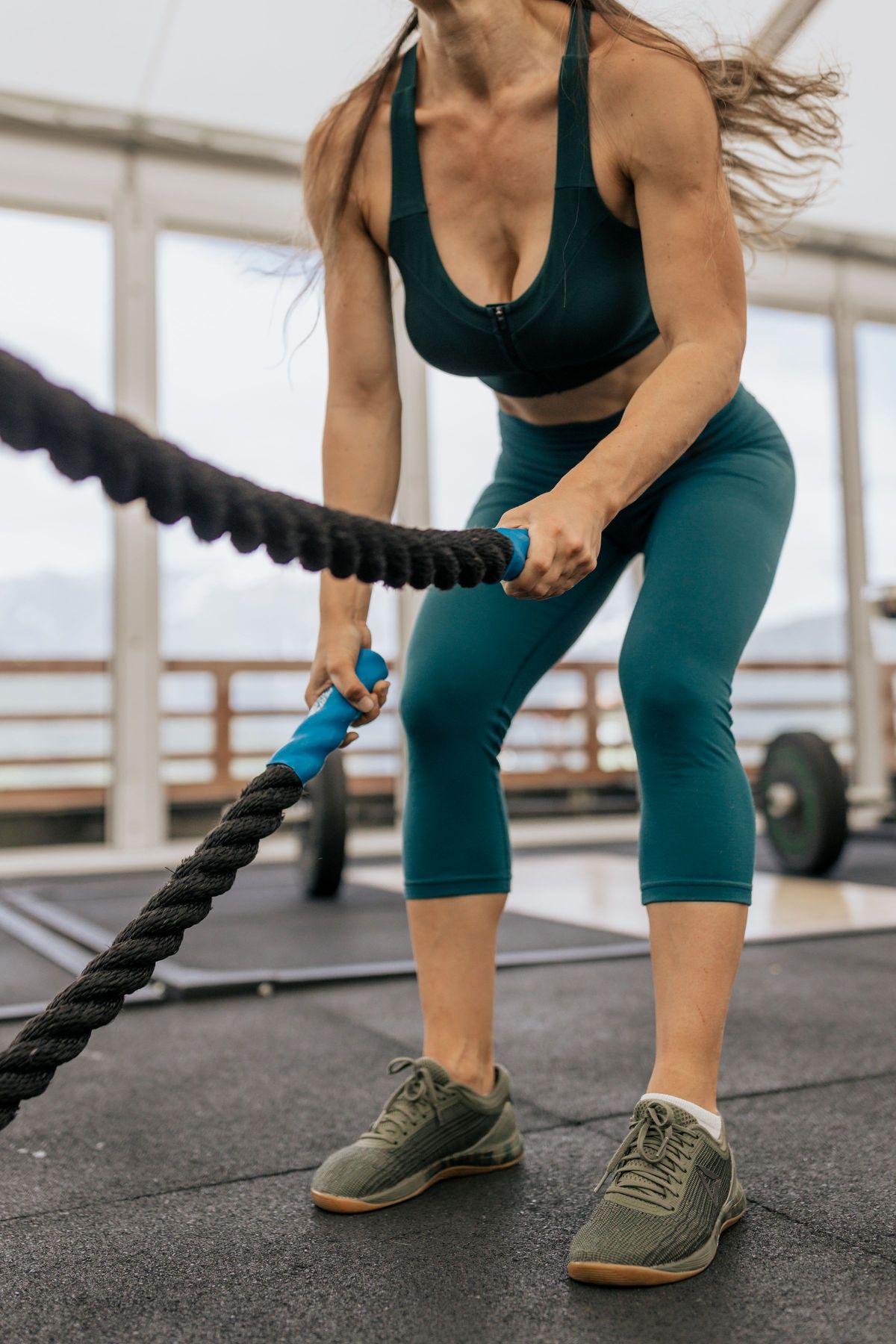
Waves, slams and circles. Easy to scale, surprisingly tiring.
Sleds
Push or drag along the turf. Load goes up or down in seconds.
The session
What forty-five minutes feels like
- 0–8 min. Warm-up and a walk-through of each station.
- 8–35 min. Two interval blocks with a three-minute reset between them.
- 35–40 min. A short finisher. Optional, always scalable.
- 40–45 min. Easy cool-down and stretching while your breathing settles.
Expect to be warm and out of breath, with music on and a coach calling time. It’s energetic, but never a competition.

Practical details
7 sessions a week, 45 minutes each
When
- Monday18:00–18:45
- Tuesday07:00–07:45, 19:15–20:00
- Wednesday12:30–13:15
- Thursday18:00–18:45 Good first class
- Friday06:45–07:30
- Saturday10:00–10:45
Prices
- First coached class£12one visit
- Single class£18per class
- 8 classes£89per month
Bring
- A full water bottle
- Supportive indoor trainers
- A small towel
- Tell us about any heart, lung or joint concerns when you call
Conditioning FAQs
Common questions
I’m not very fit. Is Conditioning too much?
Not if you stay on the Steady pace. Many people start there and stay for weeks. You can also take extra rest at any point.
Is there jumping?
Only if you want it. Every exercise has a low-impact version, and your coach will show you both.
How is this different from Strength?
Strength is about lifting with full rests. Conditioning is about keeping moving with short, timed recoveries. Read Strength or Conditioning? for more.
Can I do Conditioning the day after Strength?
Yes, though if you’re new, a rest day or a Mobility class in between helps.
First class £12
Call about your first Conditioning class
Tell us how active you are now and we’ll recommend a session and a starting pace.